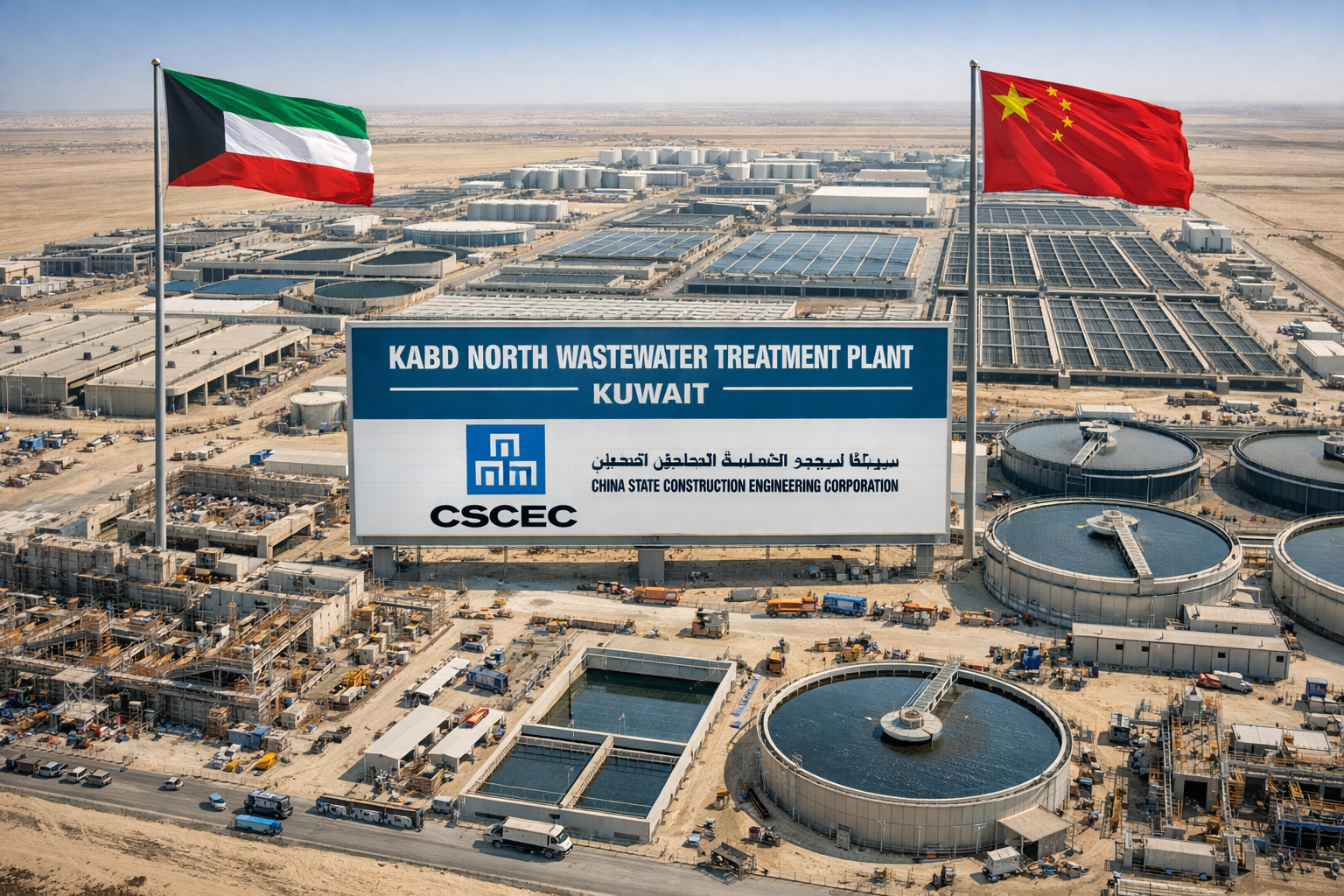
Kuwait has approved a major $3.3 billion contract for the Kabd North wastewater treatment plant, marking an important step for the Kuwait wastewater PPP project and the country’s environmental strategy. The Central Agency for Public Tenders cleared the Ministry of Public Works to sign with China State Construction Engineering Corporation (CSCEC). The deal is valued at 999.85 million Kuwaiti dinars, or about $3.276 billion.
Once completed, the facility will treat up to one million cubic meters of wastewater each day. This makes it Kuwait’s largest plant by capacity. In addition, CSCEC will operate and maintain the site for ten years. This approach follows PPP best practices, where one private partner manages delivery and performance. Kuwait’s current national treatment capacity stands near 800,000 cubic meters daily. Therefore, Kabd North will significantly expand coverage. The project also supports Kuwait Vision 2035, which focuses on sustainable infrastructure and private-sector participation.
The Kabd North project comes as Kuwait faces ongoing wastewater reuse challenges. Large volumes of treated water are still discharged into the sea. Limited storage and weak distribution networks remain key obstacles. Moreover, water quality standards restrict reuse mostly to irrigation.
To address this, the plant will use advanced treatment systems. These upgrades aim to support wider industrial and agricultural reuse. At the same time, the Kuwait wastewater PPP project applies an integrated delivery model. Construction, operation, and maintenance sit under one contract. This structure shifts performance risk to the private partner. Across the Gulf, similar PPPs have attracted billions in water investment. Saudi Arabia and the UAE already use this model at scale. Studies also show lifecycle PPP contracts can cut long-term costs by up to 15%. As a result, Kuwait expects better efficiency while easing pressure on public finances.
Relations between Kuwait and China have strengthened in recent years through expanding cooperation in infrastructure, energy, and environmental projects. Today, the Kuwait wastewater PPP project stands as another milestone in that partnership. Chinese firms bring advanced engineering expertise, while Kuwait provides long-term policy direction and investment support. Looking ahead, PPP experts see Kabd North as a regional reference for large-scale water projects. The scheme demonstrates how structured partnerships can attract foreign capital, improve environmental outcomes, and support economic diversification. Ultimately, Kabd North reflects Kuwait’s growing shift toward sustainable infrastructure delivered through modern PPP frameworks.