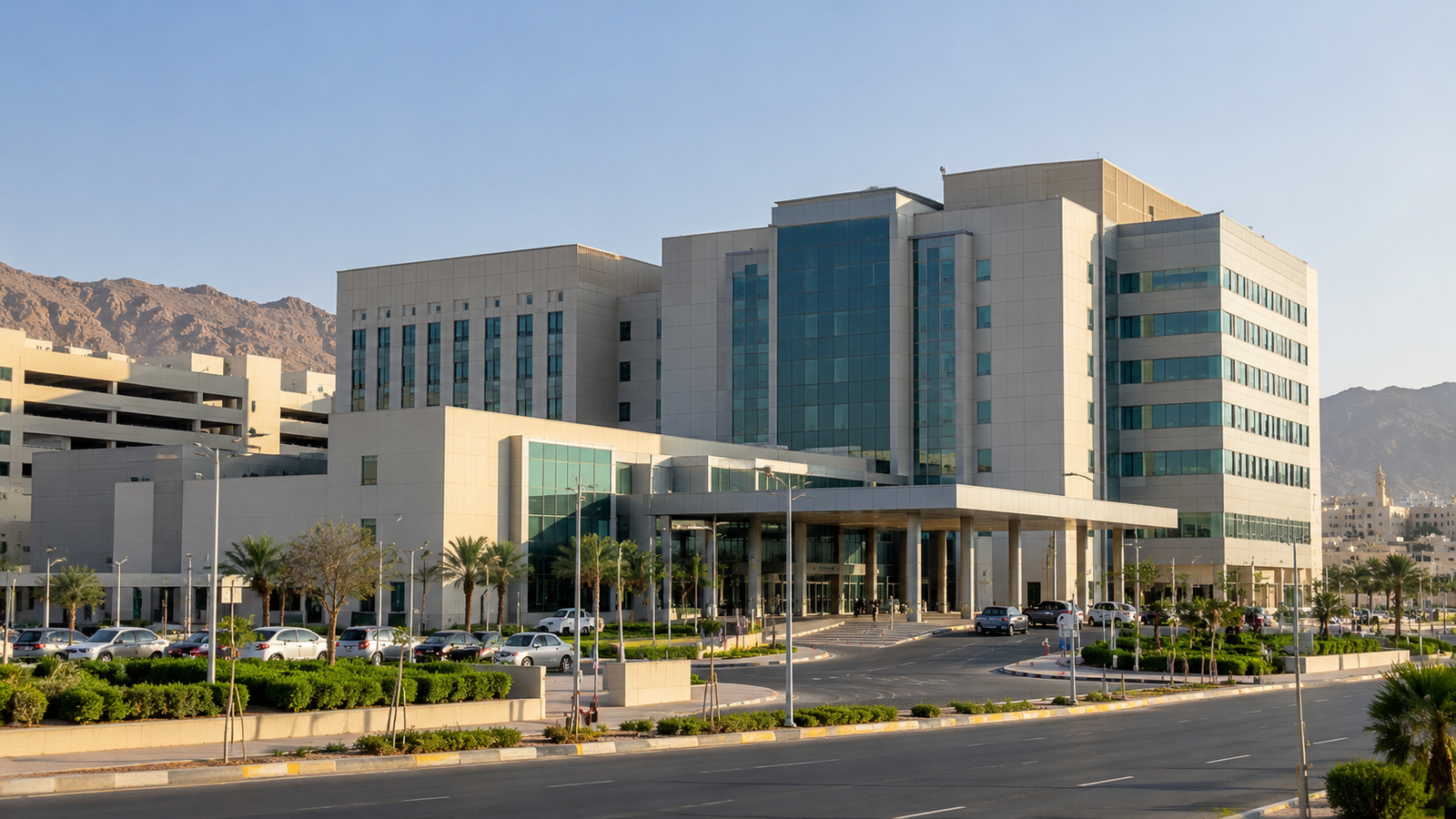
The Umm Al Qura hospital project in Makkah has attracted expressions of interest from 73 local and international companies. Saudi Arabia plans to complete and operate the 391-bed university hospital through a public-private partnership. The strong response gives the government a broad field for the next procurement stage.
Umm Al-Qura University is advancing the project with the National Center for Privatization & PPP (NCP). The Ministries of Education, Finance and Investment are also supporting the transaction.
NCP information reported on September 28 shows that 65 Saudi companies and eight international companies responded to the EOI launched earlier this year.
The respondents include 28 developers, 14 healthcare operators and 13 contracting and facilities-management companies. The list also includes 11 consultants, five equipment and service providers, and two financing and investment firms.
Companies showing interest include Tamasuk, Saudi Binladin Group, Ramky Infrastructure, Dallah Health, Aster DM Healthcare, InterHealth Canada and Saudi German Hospital. Aljazira Bank and Lebanon’s BLOM Invest appeared in the financing and investment category.
The response demonstrates significant market interest. However, the authority has not yet announced a shortlist, bid award or financial close.
Umm Al Qura hospital uses a 30-year DBFOM model
Saudi Arabia has structured the project as a 30-year design-build-finance-operate-maintain concession.
The private partner will do more than complete an unfinished public building. Procurement information indicates that the successful consortium will rehabilitate and complete the remaining construction works. It will also finance the project, equip the hospital and maintain the facilities.
Importantly, the private partner will provide integrated clinical services. These will include inpatient, outpatient, emergency, surgical and diagnostic care. The hospital will also provide core medical specialties and supporting medical services.
The Umm Al Qura hospital will retain an important academic function. It will support medical education, clinical training and scientific research for Umm Al-Qura University.
This broad scope makes consortium composition particularly important. A developer or contractor will need strong healthcare operating expertise. The consortium will also require financing capable of supporting its obligations throughout the 30-year concession.
The 73 EOI respondents therefore do not represent 73 separate project companies. Many could join future bidding consortia as developers, operators, contractors, equipment providers, advisers or financiers.
The government has not yet confirmed the final bidder shortlist or detailed procurement timetable.
Bankability of the Umm Al Qura hospital project
The next procurement documents will play a major role in determining the project’s bankability.
Investors and lenders will want clarity on how the government intends to pay for private capital investment and healthcare services. Hospital DBFOM projects can use availability payments, service payments and performance deductions. However, the authority has not yet confirmed the final payment mechanism for this project.
Several other risks will require careful allocation.
The private partner will complete an existing structure. This raises questions over latent defects and responsibility for earlier works. Procurement documents will also need to address medical-equipment replacement, clinical standards, staffing and patient-volume risks.
The interface between university teaching requirements and hospital operations will require particular attention.
The Umm Al Qura hospital project also appears to transfer responsibilities that many traditional hospital PPPs leave with the public sector. Clinical service delivery increases the operational and performance risks carried by the private partner.
Lenders will therefore examine payment security, termination compensation and change-in-law protection. They will also assess the deductions regime for service failures.
The involvement of NCP and the Ministry of Finance provides an established institutional framework for the transaction. Interest from banks and major healthcare operators also suggests that potential consortium members are assessing how to structure and finance these risks.
Umm Al Qura hospital expands Saudi healthcare PPP pipeline
The project supports Saudi Arabia’s wider policy of increasing private participation in public services under Vision 2030.
Its significance comes from the depth of private-sector responsibility contemplated for a university hospital.
Instead of procuring construction separately and later outsourcing selected services, the DBFOM structure brings construction, financing, lifecycle maintenance and operations under one long-term arrangement.
This approach can encourage the private partner to consider whole-life costs from the start. Better integration between construction and operations can also improve lifecycle planning.
At the same time, the structure places greater demands on public-sector contract management. Authorities must monitor clinical quality, infrastructure performance, payment deductions and academic requirements throughout the concession period.
The 73 expressions of interest give NCP and Umm Al-Qura University evidence of strong market interest across the skills required for the project.
The next test will come when the authority converts that interest into qualified bidding consortia and binding offers. Until it announces the shortlist and detailed tender documents, the Umm Al Qura hospital remains at the procurement stage rather than the award stage.